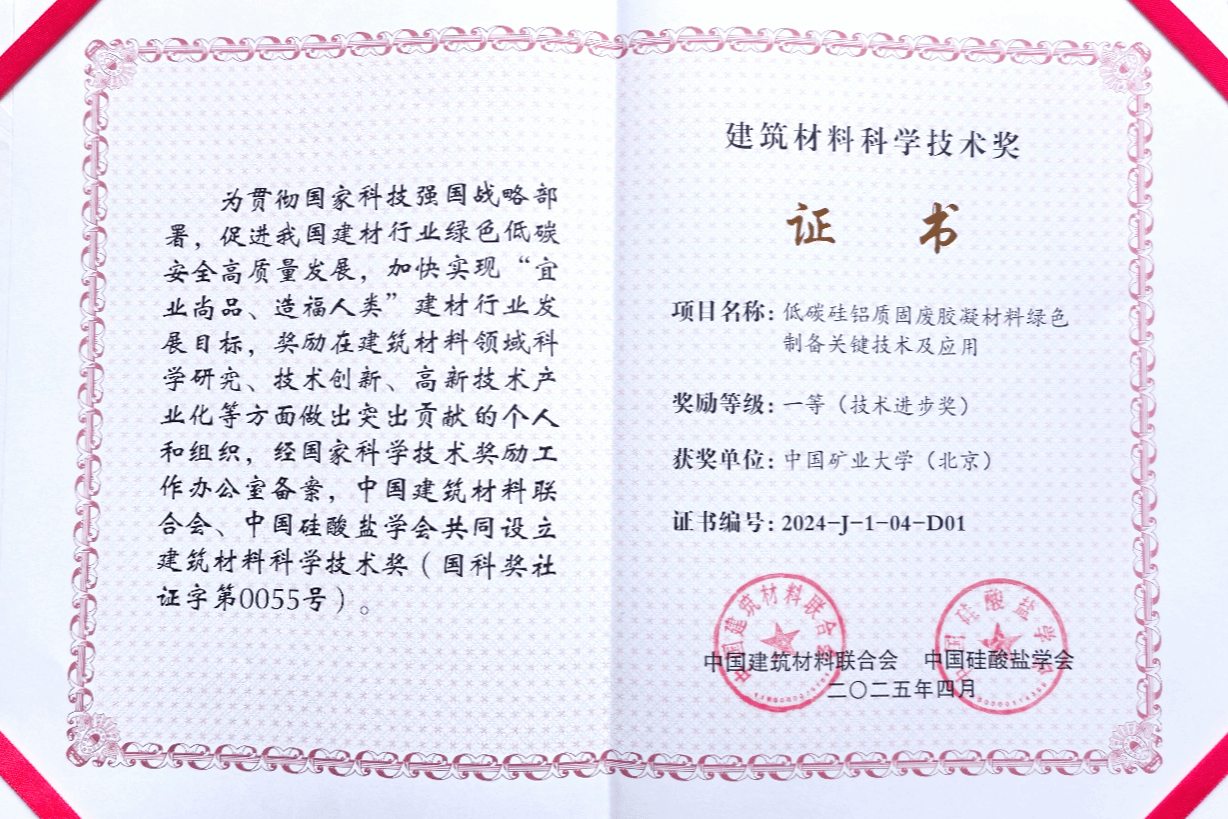
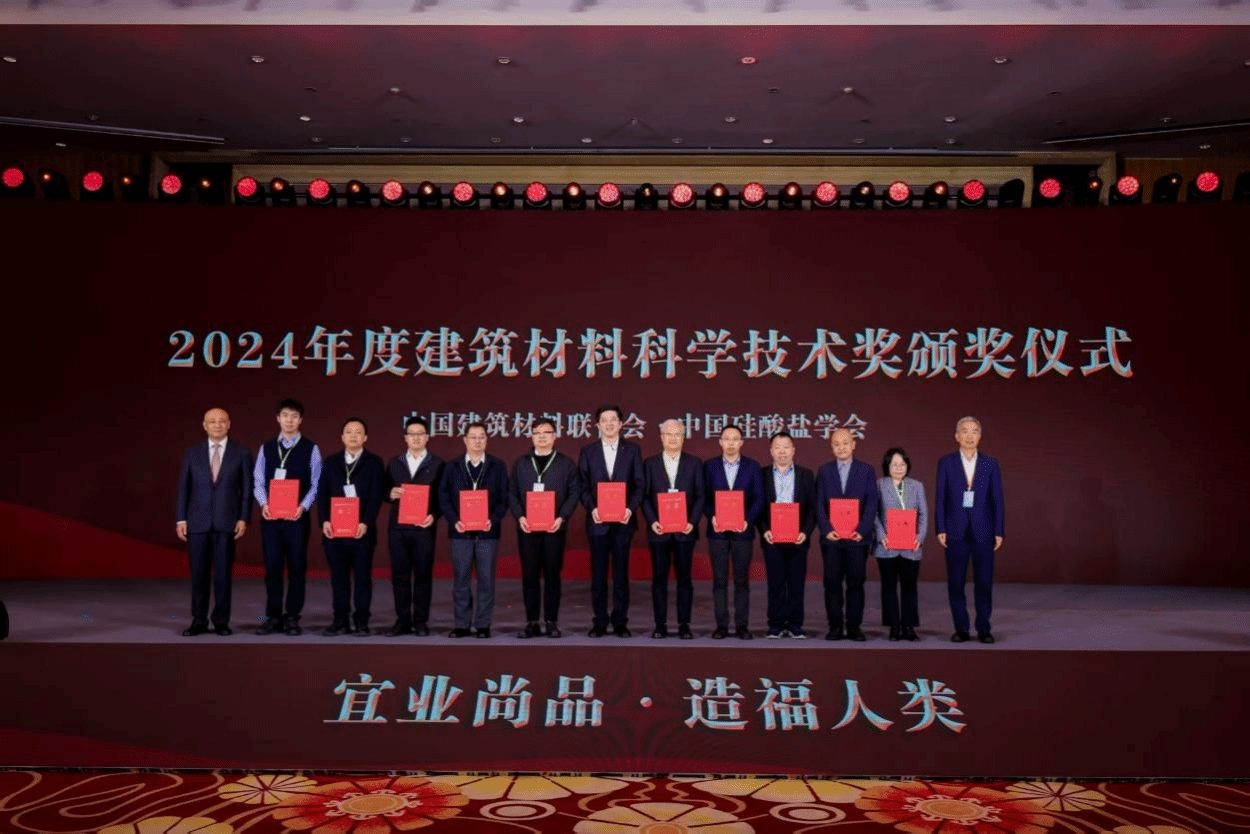
On December 3, the 2025 Building Materials Industry Conference was held in Ningbo, Zhejiang Province, jointly organized by the China Building Materials Federation and the Chinese Ceramic Society. During the conference, the Industry Conference on Scientific and Technological Innovation was convened, and a ceremony was held to present the 2024 Building Materials Science and Technology Awards, with a total of 69 projects receiving honors. The project titled “Key Technologies and Applications for the Green Preparation of Low-Carbon Aluminosilicate Solid-Waste-Based Cementitious Materials” won the First Prize of the Science and Technology Progress Award of the 2024 Building Materials Science and Technology Awards. The University served as the leading institution for the project, with participation from Wuhan University of Technology, Shanghai Geopoly New Materials Co., Ltd., China Northeast Architectural Design & Research Institute Co., Ltd., and Yingtou Information Technology (Shanghai) Co., Ltd. The principal contributors to the project include Wang Dongmin, Chen Wei, Liu Ze, Wei Peng, Zhang Xinlong, Li Qiu, Wang Jixiang, Zhu Yingcan, Li Xiaohui, Liu Tao, Wang Zhenbo, Sun Rui, Fang Kuizhen, Li Bo, and Yuan Bo.
The project “Key Technologies and Applications for the Green Preparation of Low-Carbon Aluminosilicate Solid-Waste-Based Cementitious Materials” centers on the development of a novel cementitious system and carries out in-depth research on the large-scale, stable, and low-carbon utilization of bulk industrial solid waste to produce new aluminosilicate-based cementitious materials. The team developed technologies to enhance the reactivity and stabilize the quality of multi-source aluminosilicate solid wastes, and established a new low-carbon cementitious material system based on multicomponent aluminosilicates. In addition, new green preparation technologies for low-carbon aluminosilicate solid-waste-based cementitious materials were developed, along with application technologies for typical engineering scenarios, including radioactive waste disposal, road subgrade construction, goaf backfilling, and building engineering. These innovations have significantly improved the adaptability of the materials and provided strong support for national infrastructure development and specialized engineering projects.
The project has resulted in 46 authorized invention patents, 16 utility model patents, 10 technical standards, 8 monographs, and more than 120 academic papers. Its technologies have been applied in over 100 major engineering projects across China, including mine backfilling, nuclear waste disposal, road construction, and building engineering. Over the past five years, more than 10 million tons of low-carbon silico-aluminous solid-waste cementitious materials have been used, enabling the utilization of over 9 million tons of industrial solid waste. These achievements contribute significantly to China’s carbon peaking and carbon neutrality goals and the advancement of ecological civilization, while strongly supporting the high-quality development and low-carbon transition of the cement industry.


